

Choosing the best Wooden Doors for your home means balancing appearance, performance, and everyday use. A door may look beautiful in a showroom yet feel awkward in a narrow hallway or swell during a damp season. Start by deciding where it will be installed. Interior doors face different demands from exterior doors, which need stronger weather protection, secure hardware, and properly fitted seals. Measure the opening carefully, including its width, height, and wall thickness.
Next, consider the wood and how the door is built. Oak, maple, and pine each have distinct grain patterns, colors, and maintenance needs. Solid wood offers a substantial feel, while engineered construction can provide greater stability in changing indoor conditions. Ask about the core, veneer, finish, and care requirements before comparing prices. Touch the surface. Check the edges. Small details matter. A smooth finish and even joints can signal careful workmanship, though appearance alone cannot confirm durability.
Think about your home’s lighting, furniture, and daily routines. A dark-stained door may add contrast, but it can make a small room feel heavier. A glazed design can bring light into a hallway, yet it may reduce privacy. Wood also responds to humidity, so even a well-made door may need adjustment over time. That is easy to overlook. This guide explains how to compare styles, materials, finishes, and practical features, helping you choose a door that suits your space rather than simply following a trend.
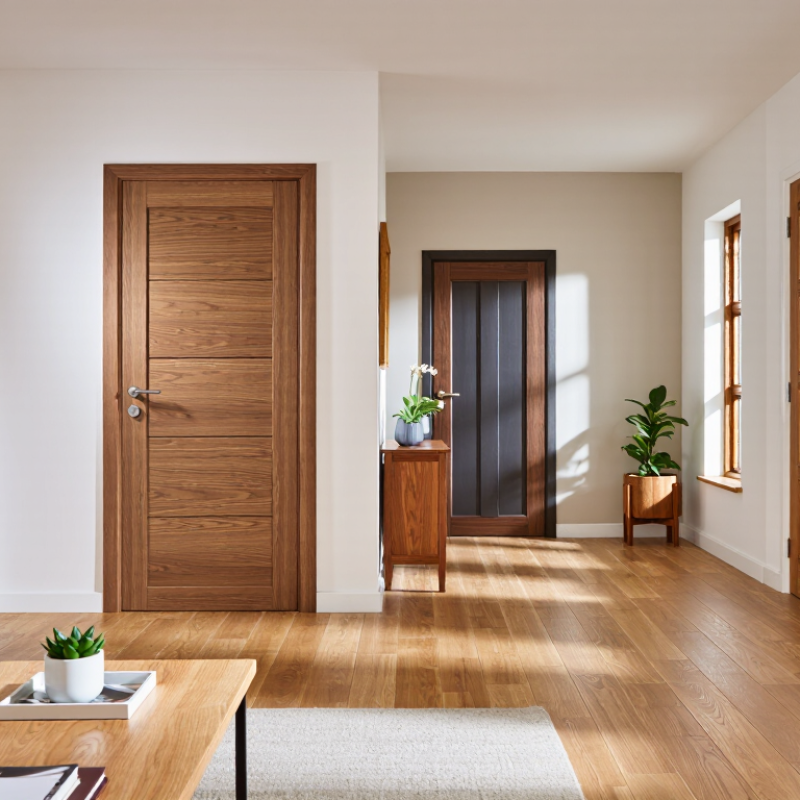
Solid-wood doors
Wooden doors differ in how their cores and outer surfaces are built. A solid-wood door is made from joined timber, with grain that remains visible across its face. It feels substantial and can sometimes be trimmed, within the maker’s limits. Seasonal humidity may cause swelling or small gaps. Check the fitting guidance.
Engineered solid-core doors
Engineered solid-core doors have a dense composite center, often covered with timber veneer. They usually feel sturdy and may reduce sound transfer better than hollow-core doors. Their construction can also be more dimensionally stable than solid timber. Still, a thin veneer may not tolerate deep sanding. Inspect the edges.
Hollow-core doors
Hollow-core doors use a light frame around a honeycomb or similar filling. They suit closets and quieter, low-traffic rooms, but resist impacts and sound less effectively. Feel the weight. Flush faces are easy to wipe clean, while raised panels add visual depth. A panel describes the style, not the core, so it does not guarantee strength.
It is easy to focus on grain or color and overlook sound privacy; compare construction, finish, and weight for the room where the door will hang.
A door should fit the work a room asks it to do, not just repeat one look throughout the house. At the entrance, choose a wooden door built for exterior exposure and fitted with effective weather seals. Temperature changes and damp air can make wood swell or shrink. Check the frame and threshold too; a beautiful door can still let in drafts if the fit is poor.
Bedrooms often benefit from solid-core doors, which can soften noise from hallways. For a home office, that added privacy may help during calls. Bathrooms need reliable privacy, while a glazed panel is better suited to a kitchen or dining area where borrowed daylight matters. Use suitable safety glazing where glass is likely to be struck. No rule is perfect. A heavier door may feel reassuring, but it can be awkward for children or anyone with limited mobility.
Match the style to the room’s character as well as its function. Simple, flat-panel doors can keep a narrow corridor from feeling busy; raised panels may suit a traditional living room. Consider how the finish will handle fingerprints near a kitchen or scuffs beside a busy entry. Matching every door looks orderly, but it can make a home feel flat. A modest variation in panel detail can create interest without making the rooms feel disconnected.
Choosing a wooden door means comparing the visible timber with what sits behind it. Oak offers pronounced grain and good dent resistance; pine is lighter and softer, so chair backs and pet claws may mark it sooner. Maple has a finer, more even appearance. These are tendencies, not guarantees: finish, veneer thickness, and workmanship also matter. Inspect an actual sample in your room’s light.
Core construction changes weight, sound, and price. A solid-wood door is made from timber, while a solid-core door usually combines an engineered core with wood veneer. Hollow-core doors are lighter and often suit closets, but offer less sound reduction. The USDA Forest Products Laboratory’s Wood Handbook reports about 12% equilibrium moisture content for wood at 70°F and 65% relative humidity. That detail matters: in a damp room, a poorly sealed door can swell or bind. Check the manufacturer’s moisture and installation guidance, and leave suitable clearance.
Look closely at the edges and joints. A consistent veneer, tight corners, and a flat panel are practical signs of careful construction. Feel the difference. Still, a heavier door is not automatically the better choice; hinges and frames must support it. I would compare samples before deciding, because color on a screen can be misleading.
Measure each door opening at the top, middle, and bottom, since older frames are rarely perfectly square. Record the narrowest width and shortest height. Check the jamb depth too, especially if the wall has been renovated or covered with thicker trim. Check all three. A tape measure can flex, so keep it straight and take each reading twice. Compare the measurements with the door manufacturer’s sizing guidance before ordering; the opening and the door slab are not the same size.
Choose a finish for the room’s light, use, and moisture—not just a color sample. A clear finish can reveal the grain, while paint gives a more uniform look and can hide small variations. Hold a sample beside the actual floor and trim, then view it in daylight and evening light. Small differences matter. For bathrooms, entryways, or other damp areas, confirm that the finish is suitable and seal exposed edges as directed. I have seen careful color choices look different once installed, so allow for that uncertainty. Also check the care instructions: a finish that needs frequent touch-ups may not suit a busy household.
| Category | Dimension or factor | How to check | Practical guidance |
|---|---|---|---|
| Measure the opening before choosing a door | |||
| Width | Opening width at the top, middle, and bottom | Measure from one side of the opening to the other at all three points. | Use the smallest measurement when checking fit. If the measurements differ substantially, have the frame assessed before ordering. |
| Height | Opening height on the left, in the center, and on the right | Measure from the finished floor to the top of the opening at each point. | Use the smallest measurement. Account for flooring that is already installed or will be added. |
| Wall thickness | Jamb depth | Measure the wall thickness from one finished wall surface to the other, including existing trim only if the door supplier requests it. | Match the door frame or jamb to the wall construction so it can be fitted and trimmed correctly. |
| Frame condition | Square, level, and plumb | Check the opening diagonally and use a level on the sides and top. | An out-of-square opening may need adjustment; the door slab alone will not correct a misaligned frame. |
| Door swing | Hinged side and swing direction | Note which side the hinges are on and whether the door should swing inward or outward. | Check nearby walls, furniture, light switches, and other doors to prevent clashes. |
| Common sizing reference | Typical U.S. interior door leaf sizes | Common widths include 24, 28, 30, 32, and 36 inches; 80 inches is a common height. | These are common sizes, not a guarantee of fit. Confirm the exact slab or prehung-unit dimensions and required rough opening with the supplier. |
| Accessibility planning | Clear passage width | Measure the usable clear opening with the door open, not just the door leaf width. | Where accessibility is a priority, confirm local building requirements and the clear width provided by the chosen door and hardware. |
| Choose a finish suited to the wood and room | |||
| Clear finish | Transparent or lightly tinted coating | Review a sample on the same wood species; grain and color vary naturally. | Shows the wood grain. Clear coatings can change the wood’s appearance and may need periodic care depending on the product and exposure. |
| Stain | Coloring that generally leaves the grain visible | Test the stain on a sample, then apply the intended topcoat if the finish system calls for one. | Absorption varies by species and surface preparation, so a sample is more reliable than a color chart alone. |
| Paint | Opaque color coating | Check that the door is suitable for painting and follow the coating manufacturer’s preparation and application instructions. | Conceals most grain and offers a wide color choice. Seal or coat edges as directed, especially where moisture may reach them. |
| Room conditions | Humidity, sunlight, and moisture exposure | Consider whether the door is for a dry interior room, a bright location, or an area exposed to moisture. | Use a door and finish rated for the intended location. Follow care guidance and avoid assuming that a standard interior wooden door is suitable for wet areas. |
| Final selection | Appearance, maintenance, and fit | Compare wood samples, finish samples, hardware, and the measured opening together. | Confirm the door type, exact dimensions, finish compatibility, and installation requirements before purchase. |
Choose a wooden door by examining its construction, finish, and fit—not just its appearance. Look for straight stiles, tight joints, and an even finish, especially along the top and bottom edges. A solid-core door usually feels heavier and can soften sound between rooms; a hollow-core door is lighter but may dent more easily. Check the warranty and care instructions, too. Small details matter.
Moisture affects performance. The USDA Forest Products Laboratory’s Wood Handbook (FPL-GTR-282, 2021) gives wood’s typical fiber-saturation point as about 25–30% moisture content; below that point, drying can cause shrinkage. Ask whether the door has acclimated to your home before installation, particularly in a damp bathroom or a room with seasonal humidity swings. It is not a perfect safeguard.
Measure the opening at several points, since older frames are rarely square. Confirm the swing, clearance, and floor height before ordering; a thick rug can catch a door that seemed fine on paper. During installation, use shims to keep the frame plumb and leave the manufacturer’s specified clearance. Seal exposed edges after trimming, then wipe spills promptly and inspect the finish for cracks. Even careful owners may miss a small gap at first.